 “Pants on the ground
Pants on the ground
Lookin’ like a fool with yo pants on the ground.”
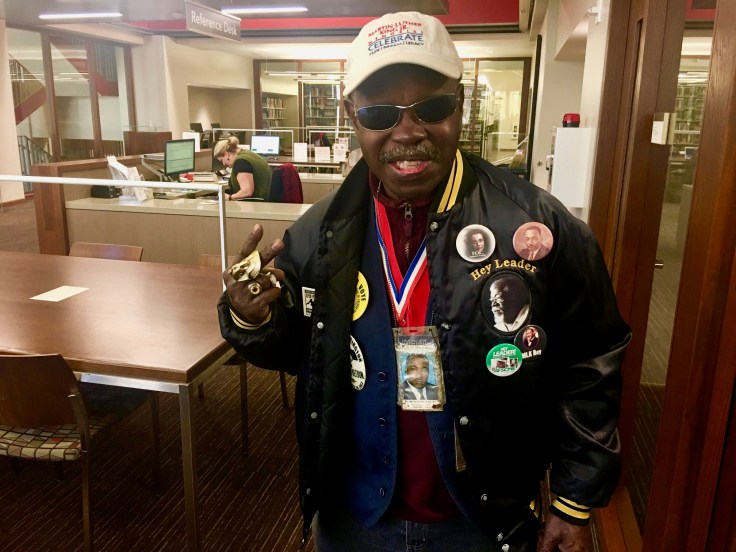
You probably remember the rapper and Civil Rights activist who sang this song on the ninth season of American Idol, the TV singing competition. “General” Larry Plat was 62 years old at the time, making him ineligible to compete in the show due to their 28-year old age limit. However, his song became a viral hit with almost 11 million views. He again was invited to perform his original song “Pants on the Ground” for the series finale in 2016 and received wide media coverage by the The LA Times, Billboard, USA Today, and Enquirer.
However, Larry Platt doesn’t seem satisfied with this brief fame. “My story ain’t never been told…No books have been wrote on me,” he tells me during our conversation at the Auburn Public Library, a place he visits quite often. His Southern accent is quite strong and representative of his character. He wears sunglasses, jeans, and black jacket. Different badges commemorating various campaign he took part in are attached to his clothes. A hat with Dr. Martin Luther King Jr. sign on it is on his head.
One of the hundreds unknown heroes of the Civil Right Movement, he feels ignored and forgotten by American society despite his brave, courageous, and fearless past. Together with legends of the movement like Dr. Martin Luther King Jr., John Lewis, and Hosea Williams, Platt participated in many Civil Rights actions. Among them were the Bloody Sunday March from Selma to Montgomery, the March for Jobs and Freedom in Washington DC, sit-ins to desegregate places like Grady Hospital, Rich’s Department Store, and many restaurants and hotels in Atlanta.
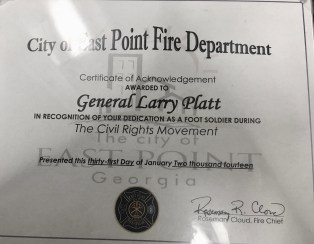 His story started in Atlanta on August, 27, 1946, in the family of Joe and Beatrice Platt. Being black and from a poor family didn’t promise an easy beginning in life. “My mama was a good lady, my daddy was a good man,” remembers Larry. When his father left the family, his mother started working to support Larry and his siblings. One day, when she was at work, the sofa in the living room caught on fire. The whole house burned down and Larry, who was still a toddler, was badly burned.
The authorities took the children away from Beatrice, and it wasn’t until she married again when she was able to bring all her children to live with her. Larry was sent to a man named Hancock who often beat him with a pair of boots. ”But I came back to my mama. My sista, brother, all came back to my mama,” he recalls.
The 1940s and 50s weren’t a trouble-free period for the black people in segregated Atlanta. Larry remembers that he wasn’t allowed to play with his white friends and go to places where whites could go. If he went to those places, whites had the right to kill him. The Ku Klux Klan was everywhere and they enjoyed impunity.
Hanna Street, located in downtown Atlanta, was one of those restricted areas. When he was 3-years old, his older sister Josefine, who was 7, took him there. The kids were too young to know they weren’t allowed to walk on one side of the street, the ‘white only’ side. Josefine grasped Larry’s hand to cross the street when she heard somebody shooting, but she didn’t know he was shooting them. Josefine noticed some blood on the ground and quickly carried her younger brother across the street. There, she looked at him and saw that the blood was coming from him, from his right eye running down to his face.
“I remember I got shot in my eye, but I didn’t know what was goin’ on,” Larry tells me. However, his sister Josefine started crying, “My brother got shot! My brother got shot!” Somebody called an ambulance and took him to Grady Hospital. The doctors were able to save his life, but at the age of 3, Larry was blind from his right eye. where the doctors saved his life, but couldn’t save his eye. At the age of 3, Larry was blind with his right eye.
At the time when black people had to endure racism and terror on a daily basis, it came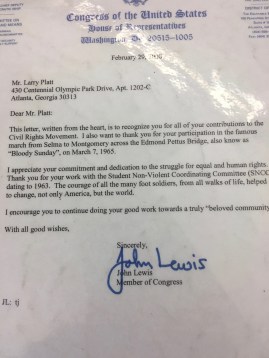 without surprise that Klansmen attacked him again. As a teenager, Larry didn’t like the segregationist way of life in Georgia and often didn’t obey its rules. He went to different places he wasn’t supposed to go. “No fear. If ya fear, if ya scared, don’t try,” he says. Several Klansmen spotted him in a gas station around the town of Adel in South Georgia and got him. They decided to hang him. They tied up his hands and his legs and hung him on a tree just outside Adel. Larry played dead, and the Klansmen left him. What saved his life were his gymnastic skills. Well trained at school, he managed to lift his knees to his neck and open the noose. Falling on the ground he broke his neck but survived.
Another time, Larry Platt went to Forsyth County and white supremacists attacked him again. They threw bricks at him and hit him on his side. He had a knot on his side, but continued to preach for peace. “Instead of responding to violence with violence, show them love and friendship,” this is General’s belief. He thinks that when you are not violent and not aggressive, aggressor feels even worse.
At the age of 7, Larry Platt did the same thing that Civil Rights legend Rosa Park did. He rode on the front seat at #20 College Park trolley, he refused to give up his seat, and to move to the back of the trolley. “They locked me up, cuz I wouldn’t give up my seat. I didn’t give my seat. They told me I was bad, told me never do that no more, but I kept on doing it.” The authorities put him in jail with grown folks. Later in his life, as a civil rights activist, he was put in jail several times. However, he admits that nothing compares to his first time experience in jail as just a 7-years old child.
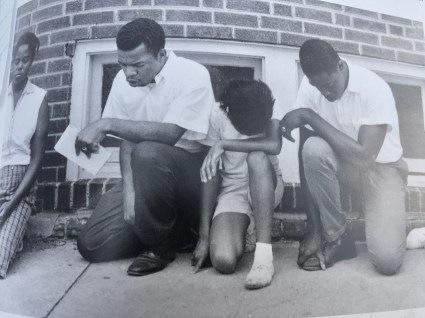 He never liked segregation. “I don’t go by the color of the skin. I go by the personality,” Larry Platt declares to me. However, in segregated Atlanta, he had to go to a black school and after it, to South West Washington High School, the same high school Dr. Martin Luther King Jr. had once attended. He was just 15 when he participated for the first time in the Civil Rights Movement. This is a photo of him and John Lewis (a Civil Rights icon and since 1987, US Representative for Georgia 5th Congressional district) kneeling in the streets of Atlanta in 1963. Lewis was the chairman of Students Nonviolent Coordinating Committee (SNCC), the organization Platt joined in 1963.
When I ask him how long he knows John Lewis, the General tells me that he even can’t remember how they two met for the first time. “I know him all my life.” “He wasn’t a violent person. You hit him, you bloody hit him up, he’d take it. He can forgive you too,” says Larry Platt. He describes Lewis as “a strong leader but not a scary leader.”
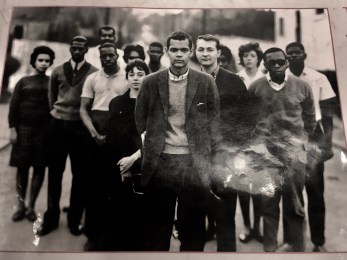 With SNCC, he participated in marches through Atlanta. They usually started from his South West Washington High School, went through Hanna, Hunter, Chestnut, and other streets in downtown, and finished at Rich’s, Christopher’s, and other department stores with segregationist rules. In those places, black people weren’t allowed to try cloths or shoes, they weren’t served food at the lunch counters, and didn’t have access to better jobs. “We knew we could be arrested, but we were there for real,” remembers Larry Platt. At the end of the day, students’ actions did change the way the department stores functioned in Atlanta.
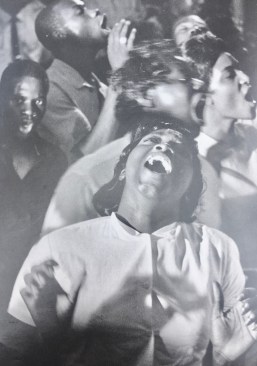 However, the change didn’t come easy. One day in January 1964, 8 students among them Larry Platt, entered the Leb’s Restaurant, an all whites restaurant just across the Rialto Theater in downtown Atlanta. The students sat at different tables and refused to go out unless they were served. Soon, they were surrounded by a white mob, and the violence was inevitable. “Lester Maddox came there, he was a dirty person. He was a KKK,” Larry Platt remembers. Maddox himself was a restauranteur, a segregationist, and Governor of Georgia. The events from that day motivated Mayor Ivan Allen to bring together the Atlanta business community and the Civil Rights Movement leaders in order to face the racial tensions in the city. As a result, since July 1964, the restaurants in Atlanta have been integrated by law.
Some of the students didn’t have enough strength to continue the fight for Civil Rights. Larry wasn’t among them. He carried on participating in the desegregation of many other places, among them hotels, Grady Hospital, and the Coca-Cola Place in Underground Atlanta. “We knew we could go to jail, we knew they were going to lock us up, but we didn’t care.” Larry Platt was arrested several times, “Some times you go there for two weeks before our lawyer come to get us out. We had to plea bargain. We had to plea for something we didn’t do or they won’t let you out.”
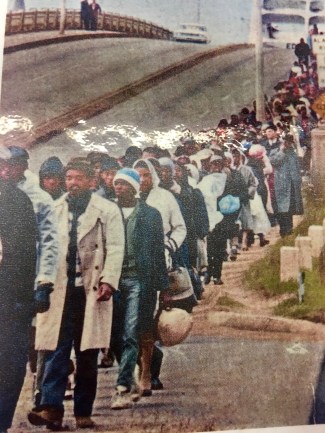 After the desegregation of Atlanta, his next big fight was voting rights in Alabama. In March 1965, he joined John Lewis and a group from SNCC together with Hosea Williams (Civil Rights activist and leader of South Christian Leadership Conference) and another group of students from SCLC, and they headed to Selma, Alabama. As every other protest, this one also started with a preyer at Brown Chapel AME (African Methodist Episcopal) Church. John Lewis and Hosea Williams told the students that the plan was to march to the state capital of Montgomery and to talk to the Governor George Wallace. The students started their peaceful protest and they attempted to cross the Edmund Pettus Bridge outside Selma. “There were state troops waiting for us. Jim Clark told us to go where we came from, told us to go back,” recalls Larry. Jim Clark was the sheriff of Dallas County, Alabama, and was one of the officials responsible for the violent arrests of many Civil Rights activists during Selma to Montgomery marches of 1965.
State troops weren’t alone. The Ku Klux Klan was right there with them. “They waited for us to get further down (the bridge), that’s when Jim Clark threw tear gas on us and ran with horses over us. We ran back toward the church. They hit John Lewis. They picked some people up, threw them in the river off the bridge. Some people can’t swim.” The images of this eventful day are still very live in Larry’s memory. “Bloody Sunday was pretty bad. It wasn’t only black, it was white people there with us, white pray there with us, together. We were all as one,” he adds. During Bloody Sunday, 50 people were injured, some of them severely, and one woman, Amalia Boynton, was beaten to death.
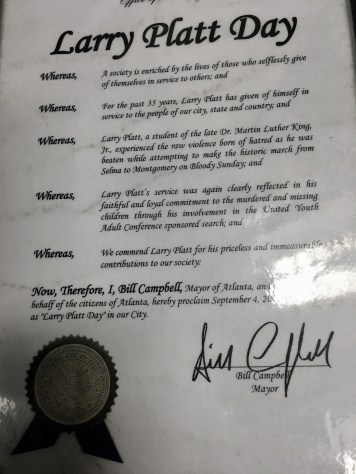 For Larry Platt, voting rights are something that is worth dying for. “I think it’s right for the people to be able to vote no matter what color,” he says and shows me his badge “Register and Vote.” He proudly assures me that since he registered to vote on July, 11th, 1968, he hasn’t missed a single election. “If you don’t vote, you have no rights to complain about this or about that.” He repeats it again, “You’ve go to stand up, if you don’t stand up there’s no use complaining about anything. Nothing.”
His own life is a proof for that. He has been arrested many times for protesting for the rights of all people because, “You have the right to go wherever you want to go. You have equal rights with everybody else. No discrimination can be put against you, the right to go to school with whites and play all together as one. You have the right to exercise your voting rights. Your first amendment (for the freedom of the speech) cannot be taken from you”, he states. Proudly, Larry tells me about the time when he attended the March on Washington, back in August of 1963. This was where Dr. Martin Luther King Jr. delivered his famous “I Have a Dream” speech. “200 000 people marched for you can get better job, better payment on jobs. If we didn’t march that day, it would never occur.” he insists.
Larry Platt smiles when he speaks about Dr. King. “He was a good person. He was a troublemaker because he wanted civil rights.” Raised in the same neighborhood as the famous civil rights leader, Larry remembers all the myths surrounding Dr. King’s early life. He talks about King’s friendship with a little white boy whose “mama didn’t want him to play with Dr. King and treated Dr. King really bad.” He also remembers young Dr. King’s fascination with firefighters that led him playing inside the Fire Station. He was punished for that because as a little black kid he wasn’t supposed to be there. Larry Platt believes that these two experiences motivated Dr. King later in his life to start the Civil Rights Movement.
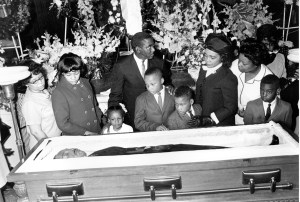 When I ask him how he got the nickname General he answers, “I was Dr. King bodyguard, I was under cover. I watched out for Dr. King’s beck.” His strategic and tactic skills as bodyguard impressed Hosea Williams who coined the nickname. “I would work out a pattern to stop the situation from happening,” he says. Today Larry Platt proudly wears the nickname General.
He heard the news about Dr. King’s assassination on the radio. Dr. Martin Luther King and his team went to Memphis, Tennessee, without informing Larry. He was left behind in Atlanta. He still feels it was wrong for them to go without him. “If I were there, I would know what to do. I would make sure that building is with security.” General believes he would have saved Dr. King’s life, “I would make sure he wouldn’t have got shot nowhere.”
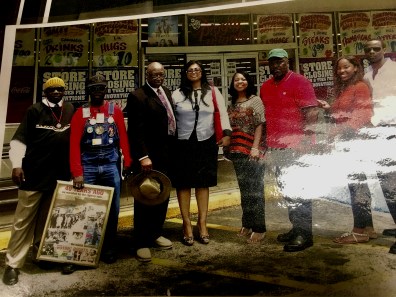 Larry Platt continued his fight for the poor and underprivileged after the end of the Civil Rights Movement because, “It is still messed up for the poor people, for the poor black people. The system is still messed up. It hasn’t changed, its still the same.” He fought to shut down a “Piggly Wiggly” store because it sold low quality food in a black neighborhood. Due to his patronage, MARTA established bus shelters at Palmer House and Roosevelt House stations. Even now at the age of 70, he does whatever he can to make people’s life better.
His big dream is to have a street named after him. General Platt cannot understand why in Atlanta there still is a Lee Street, named after General Robert E. Lee, who was a confederate army commander of the secessionist South Pro-Slavery States during the Civil War, but there is no General Platt Street. He says that he had no soldiers and he didn’t kill anybody. However, history proved the value of his ideas and believes, and buried for good the believes of Robert E. Lee.
Larry’s life-long restless effort to fight against segregation in all its forms, to secure voting rights for all people, and to improve the life of the most vulnerable citizens deserves recognition. Whether as a book, a movie, or a street. We all, who enjoy the life in modern, diverse, and prosperous Atlanta, owe him this honor.
 Maria S. Topalova Blog
Leave a comment