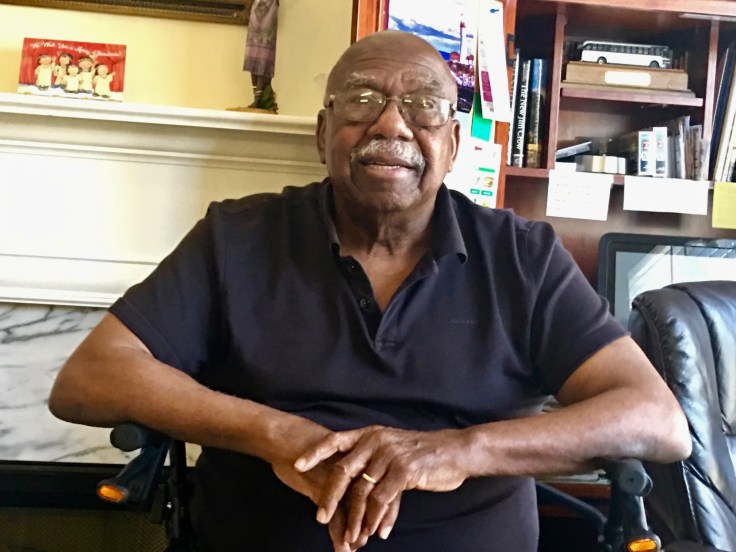
His personal answer is “Yes”. He did change the world, and made it more tolerant, more diverse, and a more inclusive place. However, he knows that there is a price for daring to challenge the status-quo because he has paid it. Several decades ago, Charles Person, an 18-year-old black student from Morehouse College, was surrounded by a white mob in Birmingham, Alabama, angry at him because he was fighting segregation in the public transportation system in the USA.
When he was attacked by the mob, he was merely sitting in a white-only waiting room at a bus station. They quickly surrounded him. Two Klansmen were holding him while a third one was punching him in the jaw, another one was kicking him in the stomach, and another one was hitting his head with an iron stick. A photographer attracted the attention (and the anger) of the mob, and saved his life.
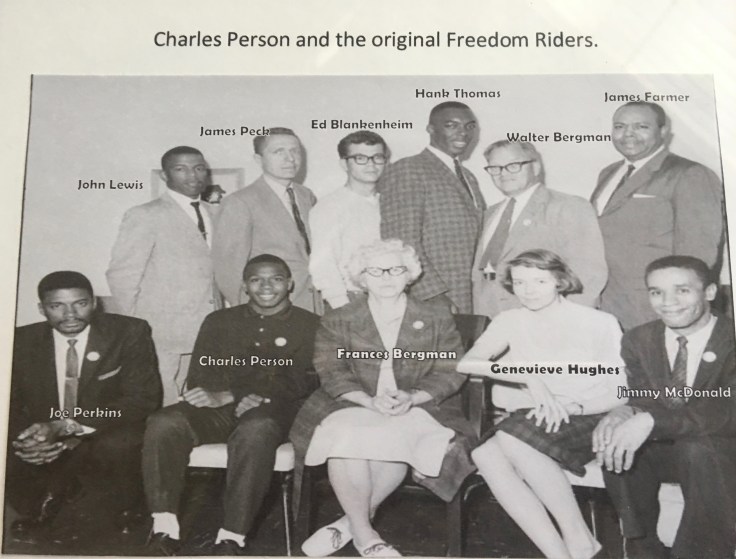
Charles Person was one of the original 13 Freedom Riders, a group of black and white men, and a white woman, who had the courage to go to the deep South in the 60s and confront its racist and segregationist way of life. They were bitten and burned; however, their fight succeeded. Due to their (and many others’) bravery and heroism, this shameful page of American History was closed for good.
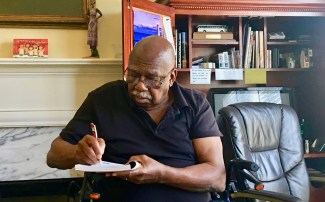
Today, Charles Person is one of the hundreds of forgotten heroes of the Civil Rights Movement, retired and disabled because, during his service in Vietnam, one of his legs was burned by Agent Orange, a special chemical used by the US Army to destroy jungle vegetation. I met him in his cozy house in a middle-class neighborhood in Atlanta and recorded his story. Here it is:
Jim Crow Era
“I was born in Atlanta, Georgia, and I lived in a community in the Fourth Ward of Atlanta, affectionately called Buttermilk Bottom. It was a place where many of the streets were not paved, the houses were small, but it was a very together community in a sense that we had everything that the larger society had. In our community, we had churches, of course, we had restaurants, we had a bowling alley, we had lawyers, and doctors, and dental offices. We had soda parlors, so we had a little bit of everything, and we didn’t have to interact with the larger white society almost on no occasions. Except on holidays when, you want to go shopping in larger department stores for gifts. But most of the time we stayed in our community. The crime was not a problem. Nobody had anything so much to take from anyone else. We all shared. If someone needed food, we shared food, or even places to stay. If somebody came to Atlanta, and had no place to stay, there were no hotels for us, they stayed with people. My family always put people up as they transitioned from the rural South to the big city.
My dad worked two jobs because he had a lot of kids. On the two jobs, he made less than a hundred dollars per week – on one he made 50 dollars, and on the other 45 dollars. He would go to work at 7:30, and we would not see him until 11 o’clock at night. That was during the 5-day working week. But it worked out well, and it taught me to be a workaholic. Later on as more kids came to our family, there were 7 of us, mom had to go to work. She worked as a domestic, and she was able to help augment the family income.
During Jim Crow, we had 6 black policemen at the time, and they could only arrest black people. They couldn’t arrest white people. There were no black firemen. I wanted to become a fireman, and I hung out at the fire station, the one that is now across from the King’s center, and I would watch the firemen. The place was always immaculately clean, and these guys had a life that was really unique. And I always wanted to be a fireman, maybe because I couldn’t be one. There were no black firemen.
In most of the department stores, there were no black clerks. The only jobs black could do these days were janitors or clean up staff like that. That was one of the reasons the student movement took advantage of, because even though the black population spent a lot of money downtown, they had no access to many jobs that were available. And of course, you couldn’t eat in the restaurants. If you go to a store to buy clothing, to places like Macy’s and Rich’s, you couldn’t try items on. If you tried them on, you bought them. So, our parents had to be very good at how to size their kids. My mom, what she was doing was to draw a line out of our feet, and take it into the shoes. When you have limited funds, you cannot afford to buy stuff that nobody will wear.
I was the oldest kid in my family. The next kid was a son, my brother. We shared a lot these days, more than now. There was more understanding than now. We understood each other’s predicament. Now there are kids who have more expensive clothing, and kids who don’t have that much. But then, we all had very little, but what little we had, we were willing to share with others.
There were a lot of silly things during the Jim Crow era. You could not sit at a table with a white person. If I can’t sit with you on a table, how could you interview me for a job? I couldn’t play chess. There are a lot of things that you and me normally do now, but they were not allowed then. I couldn’t light a cigarette of a white woman. As long as you stayed in your place, it was OK. But once you cross that line, you ran into problems, and you could be jailed or killed.
We couldn’t go to a theater. If I wanted to go to Fox Theater, I had to sit in the balcony. And at Fox Theater, there is a tremendous amount of stairs going up to the balcony. You couldn’t go to the balcony from inside, you had to go through outside. You had to climb all that amount of stairs to go to theater. I have never been to the Fox Theater for this particular reason. My parents wouldn’t allow me to do this kind of indignity. Of course in our neighborhood, we had theater, but we didn’t have first run movies. In fact, in every black community in the city, there was a theater, and a drugstore, and every little thing the community needs to thrive, we had it at our disposal.
Segregated Schools
During Jim Crow, what I can recall most were our schools. They were separated, and they were not equal. I never had a new text book. Most of the furniture in our schools were hand-me-downs. You could see the name of some white schools on the back of the chairs.
However, we had a hidden secret. White America, and white Georgia were astonished because they couldn’t understand how black kids could pass the SAT test, or ACT test, (American exams for colleges) and to go to schools like University of Georgia, and Georgia Tech. But our teachers knew what we needed to be successful, and they brought supplemental material because our textbooks were outdated. Not only were they not new, they were outdated. White schools might be on revision 5, and we were on revision 1 or two.
It surprised them because when I graduated from high school, my GPA was 3.82. I applied to MIT (Massachusett Institute of Technology), and I was accepted there. But it was cheaper to go to Atlanta, to Georgia Tech. Georgia Tech was just around the road here, and the tuition here was 375 dollars a semester, in MIT it was 1960-2000 dollars. My family, I told you, there was no way to afford even the transportation to go there or to live on campus, and all that stuff.
So, I had to apply to Georgia Tech. Of course, they wouldn’t allow me to go there, not academically. Georgia Tech had a program that you had to have two members of the Alumni to recommend you, and you had to be certified by the Superior Court that you are a bona fide resident. I had the residence requirement, because my parents paid taxes here, but there was no way I could have two members of Georgia Tech Alumni to recommend me. So, that was how I was excluded from there.
Then, I applied to Emory University. In Emory, I sent my application on a Monday, and I had my rejection back on a Wednesday. And we didn’t have express mail in those days. But it shows how determined they were that they weren’t allowing me to attend. I had scholarships from all over the country, but because of my family’s economic situation, I had to go locally.
I could have gone to Tuskegee (a private, historically black university in Alabama established by Booker T. Washington) on a five-year scholarship, but at that time Alabama was notorious, and I wasn’t going to go there. I didn’t realize at that time that Tuskegee was a city within a city, and they didn’t bother them. At that particular time, I didn’t know that. So, I decided to go to Morehouse College (a private all-male historically black college in Atlanta), which is a very good school. I have no regrets there. Segregation limited our opportunities because good education leads to good jobs, good jobs lead to good income, and with good income, you could provide for your family, and your children, and your children’s future.
This is what people don’t realize. It wasn’t because we wanted to mix with whites so much. The fact is that we were confined to low-paid jobs because they said, “You are not qualified.” And once we became qualified, they said, “You are overqualified.” When I graduated, and started to apply for job they started to consider me “overqualified.” If I am overqualified, hire me, and pay me a little bit more because you have a better product for what you hire.
When the Russians set up the Sputnik, I applied for college as soon as I could. It was supposed to be a joint venture between the US and Russia, but Russians jumped the gun. I said, “Hey, I want to be a scientist. If I am qualified, I should go to one of America’s best schools.” But that wasn’t the case. No matter what your qualifications were, they showed you how Jim Crow had hurt this country because so many talented people had been denied opportunities to do something for this country. This is what bothered me most.
It is just sad that even today, we have a problem with education. In certain areas, the money goes for this school, but in the other school they don’t have money for the latest computers, the latest software, and the other stuff. They still play this silly game. I have worked with Atlanta Public schools, and I know where the resources went – to the Buckhead schools. And what the system didn’t provide, the merchants in Buckhead provided those schools with those additional amenities.
What happened when they integrated the schools? They took the best and the brightest teachers from the black schools, and put them in the so-called integrated schools which left the intercity schools with the poorest teachers who didn’t really have the necessary skills to teach impoverished kids. This is one of the things that happened.
Civil Rights Activist
I became involved in the Civil Rights Movement when I was a freshman at Morehouse, and they had a meeting in the Quadrangle. There was a big grassy area where they could meet. They had heard about what had happened in Greensboro, NC with 4 students who sat-in. And they wanted to say we can replicate it, we could do the same thing here in Atlanta. They met with the College president, and the president said that the only way the college could support the protest was that the students should identify and articulate what they were protesting. They raised the money, and they had it published in the Atlanta Journal, and the Atlanta Constitution. We had two papers in those days, one morning, and one afternoon paper. They also published it in the New York Times. It was called “An Appeal for Human Rights”. What it did was to outline all the injustices that existed in education, jobs, hospitals, entertainment, and so forth.
We started with sit-in protests, and we were well-organized. Lonnie King and Herschelle Sullivan, they were the leaders of the Student Movement. There was a minister Reverend Boone. He opened his church up, and we had headquarters. We didn’t have any money to rent a place. Out of this office in his church, we were able to send people to various stores. We wanted to target major retail outlets – Macy’s, what was then Davidson’s, and Rich’s, now is Macy’s. And also there were Rexall drug stores. There were stores that catered a lot to white people. What we did was to send a team of people who attempted to eat. In most cases, what they did was to shut the lunch counter down. We sat there, and were doing our studies because they weren’t going to feed us. Some days when they had many people, we would leave, and they would open the lunch counter back up. Our spies at the store would call back to our headquarters, and we would send more people to the same store before they closed down.
We had certain things we wanted to achieve, and the main thing was to disturb them enough, to make them realize that there was discrimination. We went to stores that were most profitable. We wanted to go where there was a traffic of people. We were always non-violent, we were always well-dressed. In those days, girls didn’t wear pants. They were in dresses, and the guys, we went to school with shirts and ties. We might not wear a coat, but we wore shirt and tie. We weren’t mean, we weren’t disrespectful, we would ask in a very polite manner to be served.
Time in Jail
After a while, we decided to step further, and we accepted that we could go to jail. We didn’t want to accept bail, we wanted to go to jail. The idea was to fill up the jail with students so they would have little space for the bad guys. Atlanta just built a new jail on Jefferson Street, and they put us there. When I was arrested, there were 76 of us. We had 70 students arrested per day for about a week. People who were prisoners told us that since we were arrested, the food improved tremendously because they didn’t want us to know how bad the things were. There was music inside. One day we were singing songs. We were singing songs to communicate with each other. I was in cell block 1E9, and when we found out that new students were coming in, we modified lyrics of the song to let others know that we had 44 students arrive that day.
One day, I guess I was very exuberant, and they put me in solitary confinement for singing too loud. That was quite an experience for me because the size of it was 8 by 10, there was a single bunk in it, no linen, just a naked mattress, no lights at all, no reading or anything, just you and your thoughts. In the beginning, it was annoying because you have nothing except your thoughts. Initially, it weighed on me tremendously, but I got used to it. It really fortified me for the rest of my life because when I went to Vietnam, I think that experience allowed me to endure what war brings about. I had no fear in Vietnam, and I had no fear in some other cases. When the Freedom Riders were attacked, for some reason I wasn’t fearful. I probably should have been, but at 18, you are not thinking about your own fatality at that particular point. I spent 16 days in jail, and 10 of those days were in solitary confinement.
 Freedom Riders
After the jail, I was involved in the Freedom Riders action. The Congress for Racial Equality had an earlier Freedom Riders back in 1947, named Journey for Reconciliation, and they wanted to do one more in depth, going to what they call the “Deep South”. They took advantage of the fact that all over the country there were kids who were involved in sit-ins, and marches, and all the other staff. So, they sent a request for people to join the Freedom Riders. Nobody knew what Freedom Riders was. I applied along with several other Civil Rights members in Atlanta, and for some reason they chose me. Later, I found out why they chose me. At that time, I didn’t.
I had come back to Atlanta in the last 10 years, and I realized why they chose me. The reason why they chose me was that I was so young, I didn’t live enough to do anything wrong. I didn’t have negative things in my background. I had never even cut class, let alone any other crime. The reason is that J. Edgar Hoover (the first FBI Director), and the FBI wanted everybody to think that all blacks are communists, and we were smart enough to realize that the way we were treated was not fair. One of the first Freedom Riders in 1947, he was homosexual, and they found out about that, and wanted to use it against the movement. They were trying to find kids and people who were squeaky clean. That was the bill that I met.
We went to Washington D.C. for 3 days for additional training. I was already trained in nonviolence. In D.C., they simulated some things they thought might happen to you. They would poor condiments on you, ketchup and mustard, throw sugar and salt, and stuff like that. They would spit on you, put out a cigarette on you, and yank you off the stairs. We feared that this would be about the extent that we would encounter when we go on the Ride because nothing else greater than that had ever happened. Who would think that these idiots would burn a bus with people on it?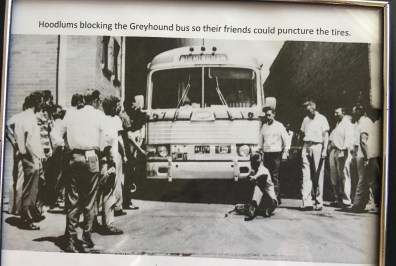
We got to Anniston, Alabama. I was on the opposite bus, because we switched busses each day. I came to Atlanta on a Greyhound, and the next day I was going to leave on Trailways (names of transport companies). My friends were on the Greyhound, and they left a couple of hours ahead of us. When they got to Anniston, Alabama, some white men lied down in front of the bus while the others were piercing the tires. When they left the station and got out of the town, on 202 (Alabama State Road) I think, the tires went flat.
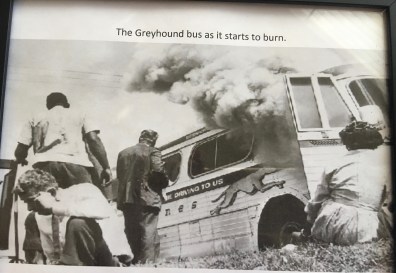 At that point, the bus driver went off and locked the door. Someone threw a firebomb at the back of the bus and set a fire. The Freedom Riders were trying to get out of the bus. The smoke started to build up, and as it got more and more, there was an explosion that startled them. The door opened for the Freedom Riders to get out, and as they came out of the bus, Hank Thomas was hit by a baseball bat. While the bus was burning, the crowd that had come from churches, I guess, was out and chanting, “Burn them niggers! Burn them niggers alive!” Literally, if the explosion had not occurred, they wouldn’t have been able to get off the bus. Eventually, they got off. Most of them were overcome with smoke and so forth. A highway patrolman was there. He came on scene, fired two shots in the air, and said, “OK, you’ve had your fun,” and
 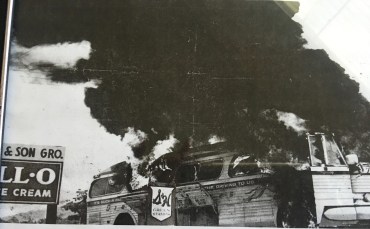 told them to back off.
When the ambulance came, they didn’t want to take black Freedom Riders. The whites refused. “If you don’t take them, we are not going either.” Finally, they got together and decided to take all Freedom Riders to the hospital. The crowd, the KKK, and their followers, followed them to the hospital and threatened them to burn the hospital if they didn’t get the Freedom Riders out of there. Our friends contacted Reverend Fred Shuttlesworth in Birmingham, and he organized a fleet of 8 cars to pick them up from Anniston.
Across town, we were on the Trailways bus. They had locked the station so we couldn’t even get out at the station. The driver got on the bus, and said, “I understand that the Greyhound bus has been set on fire, and they have taken the folks to the hospital in carloads.” We knew that these were our friends. He added, “I am not going to move this bus until niggers go to the back of the bus.” We weren’t going to move. My seat was always in the first row on the left.
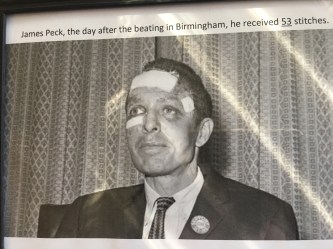 After we refused to move, 8 men got on the bus, and they started punching us. They punched me. There were punches and forces toward to the back of the bus. As we were in the middle of the bus, two of the white Freedom Riders came to our aid, and that really made the Klansmen upset. The two white Freedom Riders came to help these black students. So they hit James Peck, who was a slender built white guy, a Freedom Rider, they hit him and knocked him to the floor of the bus. He was a bleeder, and his blood covered the floor of the bus. Dr. (Walter) Bergman, who was the oldest Freedom Rider, they knocked him too to the floor of the bus. They began to stomp him on the chest until his wife begged them to stop. As they were forcing us to the back of the bus, we were sliding on James’ blood.
Eventually, they got us to the back of the bus, and they physically threw us the last portion, and eyewitnesses said they slid us like pancakes in the back of the bus. When we were at the back of the bus, a policeman got on the bus, and said, “I ain’t seen anything. No words, no lawsuits.” These were his words. And what happened was that there were no pictures. The only evidence we had what happened in this bus was what eyewitnesses wrote down. But there were no pictures to show what happened on that bus.
Anyway, the 8 guys that tossed us to the back of the bus sat in front. They taunted us all the way to Birmingham. We took an alternate route to Birmingham because someone had warned the bus driver that there was a mob down the road waiting for us. If they set our bus on fire, I wasn’t sure we were strong enough to get off it. We travelled to Birmingham, and it took us 2 hours. James Peck and I, we were the designated testers for that day. He looked at me. I knew he had been beaten pretty badly. I was punched a lot, but I had no blood. I said, “Let’s go.” We went in the waiting room, and an entire wall of men came toward us, and James went down almost immediately.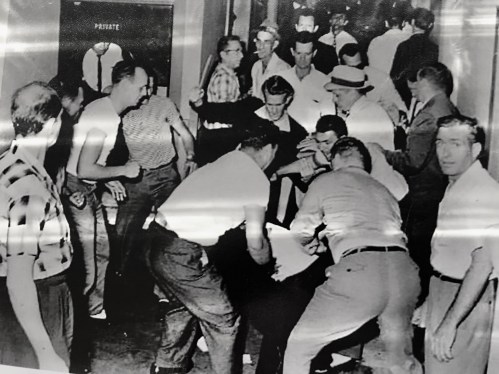
There is only one picture that has survived Birmingham, and it is of me being beaten. I guess being young, I was able to maintain my balance. When this picture was taken, it startled them, and they let me go. I just walked away. They attacked the photographer, they broke his camera. They thought they gathered all the evidence but, somehow, one print survived.
I walked away. I walked out in the street. I was bleeding and at that moment a city bus, like MARTA, came. I got there and told them, “Take me somewhere.” He drove about two blocks, and he stopped and told me, “Go across the tracks. There will be someone there to help you.” In the rural South, black folks were always called “across the tracks” because in those days, trains burned coal-produced soot, a kind of black powder substance that covered everything. When I got across the tracks, basically it was a black neighborhood where I found a phone booth. I put in a small dime, and I called Reverend Shuttlesworth. He sent several of his people to pick me up.
When they got there, they told me, “You need to see a doctor.” There were three black doctors in Birmingham. All three refused to treat me. They took me back to the church, and there was a nurse there who put a special bandage on my head.
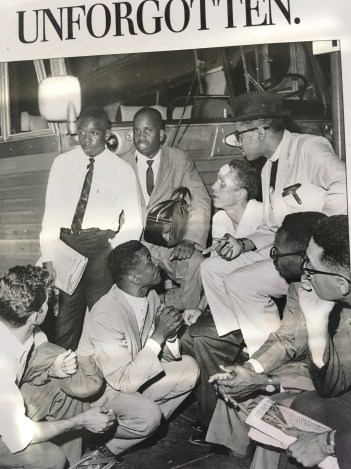 On that evening, we had a big meeting, a mass meeting, a big singalong, and we gathered all the ones who were from the smoke and the firebomb. We were trying to plan what we were going to do the next day. But the next day, no bus driver would take us out of Birmingham. They refused. They said, “No Freedom Riders,” and if another bus was going to be burned, they didn’t want to be involved.
Eventually, we voted to fly to New Orleans. We got on the plane, ready to fly. I never flew before in my life. I looked at the crowd, the mob there, because they were gathering at the airport. In those days, you didn’t have these covered gates to go to the plane. We got on the plane, and there was a bomb threat. So, we had to come back off the plane to get the plane checked out. We saw (John) Seigenthaler, one of President Kennedy’s people. He came to Birmingham, and was able to expedite, get us on the plane, and get us to New Orleans. In New Orleans, we had a rally there.
Later, we found out that the kids from Tennessee State were going to take over the Freedom Rides. We had the will, we were worried, but we wanted to continue. However, they took over, and they had their own battles. Their first encounter with the Klan in Montgomery was extremely bad because there were over 300 Klansmen to 20 students. They were lucky no one was killed.
From then on, kids came all over the country. We had all kinds of people – we had young people, old people, men and women. At the end, there were 436 Freedom Riders. 50% of them were white, 50% were black, one-fourth were women, and one-third of the Caucasians were Jews. We had at least 4 rabbis who participated. Of course, we had Catholic, and Episcopal ministers, and other religious types as well. It was a very diverse group. They all had this fire, this desire to make America a better place. They are now in their 80s. I am 75 now, and I was the youngest in the original 13. Those who are still alive, they still have this desire to make life better for all of us.
I wasn’t nearly as involved in the voting registration because Georgia was kind of smart. As a part of your Civics and American History, when you turn 18, they will take you down to register to vote. It was simple. All you had to do was to read a line from the Constitution – the US Constitution or Georgia State Constitution. If you could do that, they would register you to vote. The schools prepared us, and we didn’t have a problem here in Georgia.
The biggest problems with voter registration were in Alabama and Mississippi. Those places were notorious for preventing people. They had poll taxes. They had a questionnaire, and they asked stupid questions nobody knew the answer to. For example, how many bubbles in a bar of soap, how many nines in a bunch of nines. I’ve never even heard of a bunch of nines. There were a lot of asinine questions they asked, and there was no answer. If you couldn’t answer the question, you couldn’t register to vote. There were even people with PhDs who couldn’t register to vote in Alabama and Mississippi because of the kind of rules they had to prevent people to exercise their rights.
One of the main reasons why the desegregation of the public transportation system was important was because it wasn’t a local issue. When we did the sit-ins in Atlanta, they affected only Atlanta. If you go to Decatur, or another city, no matter how far, you had to do the same thing over, and over, and over again. With transportation, we had to go interstate, not intrastate, within the state. Interstate is Federal, and if we were successful, it would affect the entire country. When they finally passed the edict, and they enforced it, those signs came down in every bus station, train station, airport throughout the country. It laid the groundwork for the Civil Rights Act of 1964, and of the Voting Rights Act of 1965, because when those bills were passed, they affected the entire country as well. I think overall, the Movement was very, very successful.
Also, politics changed. You have to realize as we have made advancements toward change, for example, when we were protesting, there was a vagrancy law. It stated that if I was in your business, and I didn’t have at least 10 dollars in my pocket, I could be arrested. I couldn’t go window shopping like other people to the mall. If you didn’t have money in your pocket, you could have been arrested as a vagrant. And sometimes, if they arrested you as a vagrant, and you were a good worker, they would find the way to keep you in jail. We have now this increasing incarceration. You don’t have road gangs as it used to be, but they used to have. These men that were arrested were put to work, either on highways, roads, or to clean up the paper.
Marine in the Vietnam War
Later in my life, I joined the military corp because my mother thought I was gonna be killed, so she suggested I join the Army. I joined the Marine Corp because that was a better organization. Bootcamp was OK because I had learned to shoot before. I am an expert with a rifle, and I am a sharp shooter with a pistol. My grandfather had taught us as kids how to shoot because he didn’t want what happened to him and his family to happen to us.
He never told us what had happened to him. He only said, “Never again.” Bud he had an arsenal. This guy didn’t have automatic weapons, but he had two well-kept rifles, and made sure that they were clean and ready to go. He had a steamer trunk full with bullets. But he never told us, just was saying, “never again.” He had experienced things that… God knows. I wish I knew.
I wish I had been smart enough to pick his brain because one of these days I’ll probably write a book, and I would really like to articulate some of the things. Because they are the persons that made me. They gave me my values, my sense of value. I would never do anything in my life to disappoint them. Not even then, and definitely not now. I think this was one of the things that kept me off the streets, because I had wonderful grandparents and parents, that I didn’t want to disappoint them. I teach the same to my kids. Our family is our legacy. They can do whatever they want to us, but they can’t take that from us. No one can.
Back in the military, when I went to the bootcamp, my drill instructor did admire me because I could run, and I could shoot, and could do all the other things. But when he found out I had the highest IQ in the platoon, it really set him off. He did all kind of things to force me out, to drop out. But I was not a quitter, there was no way. If he knew my background, he would have known he was wasting his time.
Anyway, I volunteered to go to Vietnam a year before, but they didn’t let me because I was considered not a career marine. Then when Gulf of Tonkin happened (the incident that led to the US engaging directly in the Vietnam War), I was in the second group of marines that landed in Vietnam. Being an electronic technician, I had a very important job. I worked on mine detectors which protected us from the IEDs (Improvised Explosive Devices), and stuff like that. I also worked on sniper scopes which, if you know anything about the marines in Vietnam, our snipers were very very effective.
I had a guy who replaced my boss, and he called me “Boy.” I got upset, and I threw my rifle through the tent. He was determined that I train, well when he realized how valuable I was he backed off, but he wanted me to train somebody to do what I do so that he could have done something. Then the war intensified, and I guess he forgot his prejudice. I didn’t have any problems, in fact I had a lot of people who wanted to go on patrols, to go out in the foxholes. I don’t know why, maybe they figured out I was crazy enough to protect them, but I had no problem with younger people, my peers, throughout the military.
There were times when people were trying to, but intellectually there was no comparison. Whenever I had to compete intellectually with whites they’re in for a battle. In all my classes, electronic classes, I would be the first or the second. Eventually, most of the guys would like to stay with me, we developed steady groups, and stuff like that. And we are still friends until today. The good thing is that we could joke about race, but we never took it personally. No one ever bothered me in Vietnam because they knew I was crazy.
I had a very aloft disposition and I wasn’t afraid. I think that was what attracted people to me, the fact that I didn’t fear. God knows that when I am getting older, I think, “Boy, I should have been afraid!” I remember one of the first attacks against us when I first got to Vietnam. I was trying to communicate to the rear and my CO (Commanding Officer) came over to me, and told me, “Charlie, you need to get down!” But I knew the limitation of the rear. When we first went to Vietnam, we didn’t have the best equipment. I realized what we had, since I worked on them, I knew how well they were going to transmit. If they wanted to hear what was going on where we were, I had to be in a high ground or a higher position, which exposed me to fire. I think that’s why everybody wanted to be with me when we were out and in a dangerous situation. But I have never had a problem.
I went to the military when there were a lot of good people, very bright black marines. They couldn’t accept we were equal if not better intellectually. Even shooting. Many of us were expert riflemen, but we weren’t afforded opportunities to be snipers. We weren’t afforded opportunities to be what they call distinguished marksmanship programs. It was like, “We need you, but we don’t want you to have these extra skills.” I was expert, my brother was expert, my cousin was. We all were taught by my grandfather. All men from our family who went to the war, we all were experts. We knew how to shoot and we shot well, but we never got this extra opportunity.
Being in Vietnam I never used my talents. I would do my job, I would protect my life, and those who were around because this is what war was about. But I would never be in a situation like when I would deliberately torture women and kids who didn’t need to be. Sometimes I got to a big type of a guy who was much senior than me in rank. He was about to lose it, and I told him to settle down. When you lose control of your thoughts, you do stupid stuff, and I don’t want to be around people who do stupid stuff.
On Racism in the USA and around the World
 We have our differences here in the States with the blacks and whites, but the thing is that people in color around the world are just suffering. We cannot come together to realize that we have been manipulated. Sometimes I feel like there is somebody out there picking the fight and making you think that I am your enemy.
In fact, what I did when things were happening with black Americans, I went and had some T-shirts printed. In front it said, “I am African American,” and in the beck it said, “I am not an enemy.” In life, you learn who you can love and who you can respect. But now the line is so fuzzy. Since 45 (Donald Trump) is president, we have more anti-semitism in Atlanta and in the Jewish community all over the country. The question is what can we do. I work with young people because they are the future. They have the chance and the dynamic. Old people are settled in the way that I want to blame you, you want to blame me. Everybody must look at the mirror and realize, “Hey, part of this is my problem. It is not white people or society, it is us. We have to deal with it.”
But I realized too, when you have less resources, it is very enticing when you see all the world around you and there is no path. No one tells you how can Charles Person get from here to here. We are not telling our kids how to be successful. We don’t allow them to be successful. You don’t have to be a rap-singer or an athlete to be successful. In this city, we have many blacks who just work. They live in $500,000 homes just right down the road here. They are successful and you can be too. But someone has to tell the kids, “Hey, you can do it!”
The truth is that as the things changed, as we got better and we learned stuff, the rules changed. For example, take the affirmative action. If I want to get into a law school or medical school, generally it’s based on your GPA (Grade Point Average) and a few other things, OK, but here is what happen. Black kids realize, “Hey, if I want to go to a medical school, I have to have a good GPA.” But what do white kids do, they offered Advanced Placement classes. So instead of you graduating, I graduate 3.8 or 3.9, you take an AP course, you got a 4.1 – a 4.2. It doesn’t mean you are better then mine, but we are still in a situation where you still can’t get to a school not because white kids are better, not because they are smarter, but because they have programs in their schools that are designed to get them higher GPA than yours.
A lot of stuff has happened throughout this country. Like Tiger Woods. He has broken all kinds of records, all kinds of money. The so called big tournament in America was The Masters. His golf was so great that they went, and redesigned the course so nobody else could do it again. They’ve never done it before when Jack Nicklaus and all the white guys were doing great. The same thing they are doing with the Williams in tennis.
What I am saying is that they take an exception when we start to achieve things that every American wants to do, if they think it is too easy, they do it even more difficult. Here in Atlanta, Hank Aaron was breaking Babe Ruth’s record and what happened? He had death threats because he was breaking the record that was held by white guy for so many years. Normally in sports, you want to encourage people, especially young people to do their best and be their best.
A lot of people are not aware of the accomplishments of blacks around the world. In Africa, when they show it on TV, they only show someone in a loin cloth and distended belly that are hungry. But they don’t show the magnificent structures that are built. I always wondered as a child, and I asked my mom, “If Africa has all this gold and ivory, all this natural wealth, why are people so poor?” Most of the diamonds come from Africa, tremendous amount of gold. I can’t understand how Africa could be so wealthy, and people so poor. Because the imperialist people came over here and took advantage of them.
A Message to Next Generations
I want to say that my emphasis is on kids, young people, not just black kids, white kids. I often open my lectures, when I meet them, I say, “Before you left home today, you didn’t realize that by the end of this day you have the ability to change the world. The little you have the ability to change the world. You need to encourage each other, to support your peers.”
 Maria S. Topalova Blog
Leave a comment