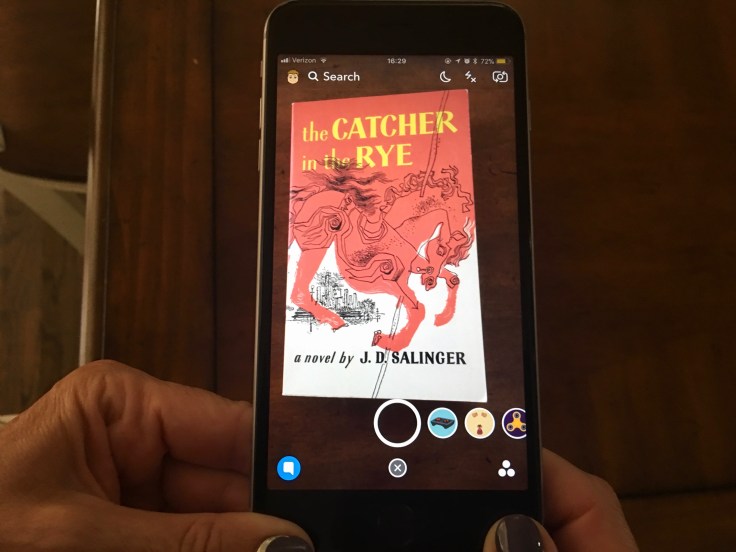
 I should have read The Catcher in the Rye as a teenager, but I didn’t. I read it recently as a mother of a teenager, and I was a kind of disappointed. The story, the character of Holden Caulfield, and the language were far below my expectations, obviously influenced by the fame of the book, and the myth surrounding the life of its author, JD Salinger, or at least the way it is presented in the movie “Rebel in the Rye,” and the documentary “Salinger.” Ironically, the legend of Salinger’s writing talent, his stormy love life, and his dramatic escape from public, outlived the popularity and the controversy of his favorite “child”, Holden Caulfield.
JD Salinger was one of the 156,000 American soldiers who landed in Normandy on D-Day during World War II. He had to survive months of heavy fighting with the Germans when he found out from the newspapers that his fiance, Oona O’Neil, became the fourth wife of the most famous actor of that time, Charlie Chaplin. When the writer returned home after the war, he had to cope with his post-war depression, worsened by his broken heart. His battle with the depression and the sentimental sadness resulted in the creation of The Catcher in the Rye.
The novel was published in 1951 and was an absolute bestseller. It sold 1 million copies in its first year alone, and in total, it has sold 65 million. Its protagonist Holden Caulfield with his alienation, innocence, and profanity has become an icon for teenage rebellion. The book was quite contentious for that time because it touched taboo issues like sexuality at the teen age, detachment between parents and children, and violence and bullying at schools.
However, for me personally, The Catcher in the Rye is the story of a spoiled, rich, white kid whose parents, instead of bothering to deal with his character, have put him in an elite boarding school as panacea for his trouble. The boy is bored at school, and his mom and dad, rather than place him to work somewhere to earn his own pocket money, support him financially to linger in NYC, visit bars, and drink alcohol. For me, it is fascinating how this upper-middle-class melodrama could resonate with young people. To find the answer, I asked my 15-year-old son to read the book, and to tell me his opinion about the following 10 questions. Here are his answers:
What do you think about “The Catcher in the Rye”? What do you like in it and what you don’t?
The element of the book I enjoyed the most was how it was written in first person. The language, style and ideas that went through Holden’s head, perfectly describes the probable thought process of a teenager at that time. However, in this day and age, I consider him more of a peculiar, spoilt and slightly psychopathic character. Overall, The Catcher in the Rye explores the life of a spoilt and neglected teenager with little to no understanding or care for the world outside of his bubble.
Which is your favorite part of the book?
My favorite part of the book has to be towards the end, when Holden takes his sister Phoebe to the zoo and then watches her ride the carousel, almost in tears. This is one of the few moments in which Holden appears to be more normal and I personally even started to feel sorry for the way in which he turned out to be. To add to that, we also see how Phoebe is one of the most important people in his life.
If you compare it with “Catch 22”, which one is more attractive to a teenage reader like yourself?
I believe that “Catch-22” is the better book. First and foremost, it has a clear storyline, with more action and enthusiasm that would be more entertaining for someone my age. The topic of war is also a very attractive theme, especially when mixed with humorous and cunning characters. Despite this, many view Catch-22 as a confusing and weird book and might find the clearer language and time-lapse of The Catcher in the Rye closer to their liking.
One of the reasons the book was banned in some schools is the use of profanity. Did the language in some parts upset you? You listen to many rappers. How does their language compare to the vocabulary of Holden Caulfield?
I was not particularly upset or even shocked by the language, but it would not be appropriate for schools. The language of rappers and other such artists is very different to Holden. They are definitely more vulgar and aggressive, but at the same time, the standard has been lowered, more of the words that Holden used then are common to hear nowadays.
Sexuality in teen age was another sensitive subject back in the 60s and 70s. Now in 2017, can you openly discuss it with your friends or teachers?
I don’t think it’s an ‘open discussion’ you can have with friends or teachers, but most schools have a very active ‘Sex-Ed’ system to ensure that as the children grow, they will be more open on the topic. The country as a whole has developed massively since the 60s and 70s and there is a less hostile approach to sexuality, but it’s still not a very common conversational topic.
How could you imagine Holden Caulfield in the age of Snapchat and Instagram? How different would his character be now?
One of the main feelings that Holden experienced during most of the novel was boredom and laziness. In our age this would simply be replaced by him being more on his phone rather than talking to friends or anyone in fact. I also believe that he would not have been much of an outcast and perhaps would have even been more normal. The schools would have definitely been more tolerant to him and might have not even suspended him.
Why, in your opinion, does Holden hate so much the world of his parents’ generation?
One of the main reasons he doesn’t like the generation of his parents is because by sending him to expensive schools they rightfully expect more from his grades. This puts a great deal of pressure on him and instead of actually trying to succeed, he decides to not care at all. I also think he feels neglected by them, as they sent him to boarding school and he therefore spends little time with them. Since he’s only been to boarding schools, he assumes that every parent is like his. To add to that, he thinks of them as very flamboyant, rich and out of touch, without realizing that he is just like them.
What are the most important issues you and your friends face now? Compare them with the issues Holden Caulfield was dealing with.
There are few ‘issues’ that are discussed between friends. I think that the main one is about grades and school work, that Holden had little to no interest in, and also from time to time on-going news. We also discuss video games and sports. Holden faces more serious issues since he is more independent than we are and has to think more about places to stay, spending money wisely to ensure that he has enough to get back home, amongst other things.
JD Salinger never agreed to have his novel filmed. If he agreed, which actor would be the best choice for the role of Holden?
After his performance in The Wolf of Wall Street, I think that Leonardo DiCaprio (at a younger age) would be a good fit for the role. I also think that other actors such as Channing Tatum or Zac Effron would also be able to play the role well.
Would you recommend “The Catcher in the Rye” to your friends and why?
I would not recommend ‘The Catcher in the Rye’ to friends, at least not at this age, because it would not be interesting to them. The book starts of at a slow pace and there is no climax or peak, with just more complaining and confusion from Holden. Despite this, it seems to me that the book was not written for this purpose, it was not written for children my age to be entertained, but rather an inside view of what life is like for teenagers during the 50s.
Obviously, the generation has changed and today’s teenagers do not identify themselves with Holden. Boarding schools are no longer a symbol of elitism. According to the American sociologist Peter W. Cookson Jr. (2009), the elitist tradition of preparatory boarding schools has declined due to the development of modern economy and the political rise of the liberal West Coast of the United States of America. The EU – Canada project “Child Welfare Across Borders” (2003), an important international venture on child development, considers boarding schools as one form of permanent displacement of the child. The term Boarding School Syndrome was coined by psychotherapist Joy Schaverien in 2011. It is used to identify a set of lasting psychological problems that are observable in adults who, as children, were sent away to boarding schools at an early age. There is no doubt that Salinger’s masterpiece has contributed to the changed public opinion.
On the contrary to the declined popularity of Holden Caulfield, the myth of JD Salinger is still alive and intriguing. In 2013, the biographic documentary Salinger was released. Writers, film directors, journalists, photographers, friends, and his two daughters talk about his extraordinary talent, his relationships with women, his struggle to find his true self in literature and in his personality, and his voluntary isolation from public life. And just a couple of weeks ago, the movie Rebel in the Rye again brought our attention to Salinger, this time focussing on the writer’s participation in World War II, his post-war depression, his broken relationship with Oona O’Neil, and the creation of The Catcher in the Rye.
JD Salinger didn’t want to see his favorite character Holden Caulfield on the screen, and didn’t want to publish anything after this novel. He spent many years writing stories and novels, but he preferred not to share them with us. However, he cannot forbid us from exploring, researching, discussing and applauding his legacy.
 Maria S. Topalova Blog
Leave a comment