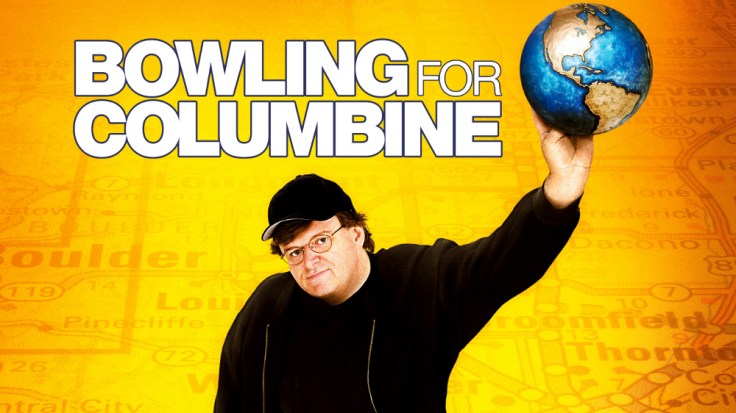
 In 2002 in his Academy Awards acceptance speech, the American director Michael Moore complained that although he likes non-fiction, he lives in a fictitious world. His film “Bowling for Columbine”, an investigation of America’s culture of gun violence, won Oscar for best documentary. Ironically, it could be characterized as non-fiction with plenty of fictitious content.
15 years later, the topic of the film remains crucial for American society. 2016 was marked by the Orlando night club shooting leaving 49 people dead. 2017 started with Fort Lauderdale shooting killing 5 and injuring dozens. However, Moore’s manipulative directing style, false statements, generalizations in the absence of evidence, and anarchist views, undermine the judgment of the Film Academy.
There is no doubt that Michael Moore is a skilled director and “Bowling for Columbine” is a great documentary. The film is centered around the massacre at Columbine High School, on April 20th, 1999. Eric Haris and Dylan Klebold killed 12 students and one teacher before they killed themselves. However, the director’s ambition is much bigger than just recalling these tragic events. It is to explore, analyze and explain the reasons for the culture of gun violence in the USA.
Michael Moore is very entertaining when he acts and is quite annoying when he makes political conclusions. He can be funny when he opens account at a bank to receive a free gun or when he meets the Michigan Militia group. He can be motivating when he brings two students, who survived the massacre, to Kmart’s headquarters and actually persuades the company to stop selling ammunition in their stores. He is capable to touch our hearts when interviewing the father of Daniel, one of the victims of the Columbine shooting. He could even be convincing when discussing and criticizing the Work for Welfare Program.
Although not giving easy answers, “Bowling for Columbine” asks the right questions. Why do Americans so easily use weapons against each other? Is it due to the violent history of their country? Is it because of the poverty? Or violent computer games? Or because it is too easy ot own a gun in America? No, Moore doesn’t hide his anti-war, anti-capitalist beliefs that define him as an anarchist, and his finger points to his usual suspects – government, police forces, and the media.
And here the problem comes. As A.O.Scott writes in The New York Times, “Mr. Moore, when it serves his purposes, is happy to generalize in the absence of empirical evidence and to make much of connections that seem spurious on close examination”. He several times mentions that the Columbine massacre occurred on the same day as the heaviest US bombing of Kosovo. For the record, it is not the US but NATO bombing and not against Kosovo but against the Serb occupation of Kosovo. Even if we close our eyes to such “unimportant” details, it remains unclear what is the connection between the two events.
In the documentary, the director makes some purely false statements and a simple fact-check disproves them. Just two examples. Moore states that Augusto Pinochet’s regime leaves 5000 people murdered in Chile. The accurate number is between 1200 and 3000, and only 300 of them ended in the court room. Moore also states that 500,000 Iraqi children died during the war and the post-war aftermath, not to mention the other civilian casualties. The official statistics of the government in Baghdad says that total civilian fatalities are at about 3,500 from bombing, and some 100,000 from the war’s other effects. Michael Moore is a professional. He could have easily double-checked these numbers. But he didn’t, because he wants dramatic “evidence” of how catastrophic the policy of the US government is. His exaggeration goes so far as to suggest that the CIA was behind the September 11th terrorist attack. To quote again A.O. Scott from The New York Times,” The idiocy of this statement is hardly worth engaging; it is exactly the kind of glib distortion of history that can be taken as a warrant to dismiss everything Mr. Moore has to say”. In the same line, the director insists that police and media scare people on a daily basis.
To be fair, I should admit that cinematographically Moore’s take on the Americans’ appreciation for guns is convincing. He wants to create the impression of investigative journalism, and his hand-held subjective camera serves this purpose perfectly. Everything must look like it is real, only natural lighting is used, and there are no special effects. There is a huge variety of media in the film – original footage, black-and-white video clips, still images, cartoons. The storytelling follows a mosaic composition pattern but the director, jumping from one subject to another, often looks like a hen that picks at something here and there without an obvious designation.
In conclusion, it is worth watching “Bowling for Columbine” but with a critical eye. For sure, the documentary deserves an Oscar, the Oscar for manipulation. It is still unclear what has motivated the Film Academy to make this choice. Partially, it could be the left ideology that has cast a shadow over Hollywood for decades.
 Maria S. Topalova Blog
Leave a comment