On November 9th, 1989, the Berlin Wall fell and the communist regimes all over Eastern Europe started to collapse one after the other. The symbol of the Cold war went down after years of unfruitful planned economies in the Soviet block that brought to poverty millions of people. In addition, the total and brutal oppression of the non-communist opposition, and literally the lack of freedom of speech worsened the life of the Eastern Europeans. In the following years several communist regimes in Africa, such as Congo and Angola, also came to an end. Others in Russia and China had to reform themselves into a combination of totalitarism and state-controlled capitalism.
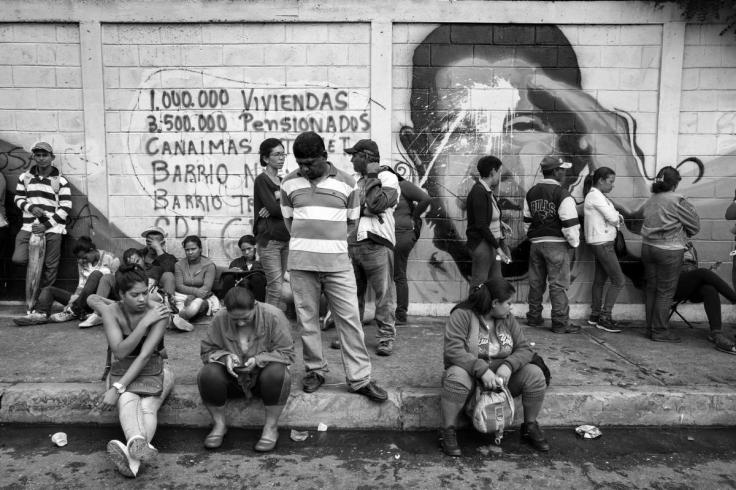
Now it is Venezuela’s turn. The nation is at the edge of starvation. The long lines for food, formally characteristic of the communist East Europe, are now daily routine for this Latin American country. The skyrocketing crime makes every day life in Venezuela even harder, and the massive human rights violations make headlines all over the world. “Communism didn’t work anywhere, and it clearly does not work in Venezuela,” Rafael Olavarria says. He is maybe one of the best sources of information about this country as he himself was one of the leaders of the student movement there and a human rights activist.
The deepest wound of the crisis is
the huge wave of immigration
Since Hugo Chavez came into power in 1999, at least 1.6 million people have left the country, or 5.5% of its population. According to Caracas based polling institute Datanalysis, 90% of these emigrants have at least college degree. “Venezuela has gone from being a country of immigrants to being one of emigrants,” Tomas Paez, a sociologist of the University of Caracas, recently told DW. “The administration of President Maduro has done nothing to stop it. On the opposite, they encourage it.”
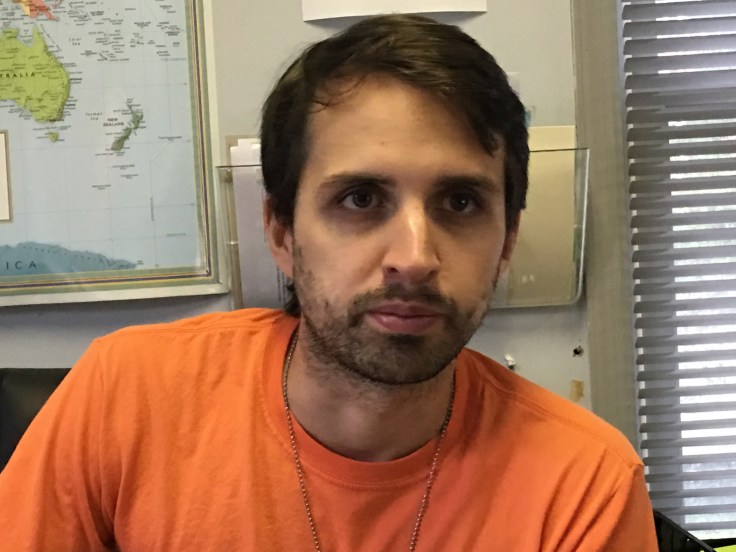
“That was not part of our plan back then to leave. It was to stay”, Rafael Olavarria insists. The 28-year old man left Venezuela in 2014, just two days before the regime raided the office he worked as a human rights activist and arrested a couple of his colleagues. “Our dream was to stay there and it changed in the last three years. Everybody who gets his diploma from the college already has a plan to leave the country. Hundreds of thousands of young people are abroad, they are all around the world, and only the parents stay back in Venezuela. This is a phenomenon. If I check my Instagram, I usually don’t see anybody in Caracas taking a picture.”
Rafael works in the evenings at the Atlanta based institute English for Internationals where we met, and during the day he is a regular contributor at CNN Espanol. The US is home to the largest Venezuelan community abroad. Just in the state of Florida alone, there are 250.000 Venezuelan immigrants. “I got to a point when I couldn’t find food or medicine, and not because I was poor but because there was nothing in the supermarket. Instead of enjoying my life as a young person, I was running from the tear-gas and the police. I love my country and I want the things to go better but I cannot say that I love my country more than my life,” he admits openly.
Nation at the edge of starvation
Rafael was raised by his mother and his grandmother in a middle class family. His mother has her own business – she supplies sea food to a chain of Italian restaurants in Caracas. In their middle class home, they had everything they needed; however, they couldn’t afford extremely expensive luxuries.Even his family now has problems finding food. They don’t have milk, or coffee, or oil, or beans, or rice and eat whatever they can find. Due to the scarce diet, his grandmother has started losing weight.
Venezuela with its oil reserves, 18% of the world’s proven oil supply, has the potential to be one of the richest countries in the world. Instead, lines for food in front of the supermarkets have become its symbol in recent years or more precisely a symbol of the total economic incompetence of the regime of Hugo Chavez and his successor Nikolas Maduro. The national economy almost entirely depends on the oil exports and the plummeting prices in the international market cause turbulence in the state budget. In 2014, a barrel of petrol was $100 and the Venezuela export was $75 billion. Now, the price of a barrel is slightly higher than $28 and exports in 2016 are expected to be $27 billion.
To worsen the situation, the government has fixed the prices of food to a level lower than the cost of the production. So, many companies stopped producing food. Sugar plantations across the country wither due to the lack of fertilizers. The country that used to export corn and rice now imports them and in minimal quantities. “I do what every Venezuelan abroad does now – send boxes of food to our parents.”
Devastated economy
The economy shrunk by 7.1% during the last quarter of 2015, and this has been the 7th contraction since 2014. The forecast for 2016 is an additional decline of 10%. “Everything deteriorated when Chavez started to harass the private companies, to control them and to close and destroy them.” Rafael says that the government controls the currency exchange and if somebody wants to import goods or to simply travel abroad, he needs the permission of the government. By no surprise, the devaluation of the national currency hits another record. Last year, with one dollar you could buy 175 bolivars. This year, you would buy 865 bolivars. According to IMF, Venezuela has the highest inflation in the world – 204%.
These numbers might be boring but they have real impact on people’s lives. “This inflation means that no matter how much money you make, you will never ever in your life buy a car. You cannot live long enough, no human being can, to save that amount of money to buy a car,” Rafael explains.
To make a long story short, the income from the oil export barely covers the debt obligations. The maturity of debt for 2016 is $10 billion and most of it is due in October and November. Economists expect Venezuela will default by the end of the year.
Rafael is convinced that the economic and social catastrophe in Venezuela is a result of the misguided populist policy of Hugo Chavez. “Because the oil prices were high, he had a huge check to spend and he bought people’s conscious.” He hopes Maduro is just “the bad ending of the Chavez legacy” and that it will come to an end peacefully without violence.
There is another aspect of his legacy that is also poisoning the society – the hatred spread among society during these years. If you are poor, this is because of the rich, so you have to hate them. The middle class is also your enemy. “There is a lot of anger and division among the people and it didn’t use to be like that,” Rafael says. He hopes that the hunger will ironically unite the people again because “I used to hate you politically and ideologically but now we are both hungry and there is only one guilty for that. Instead of the devision half of the population pro-Chavez vs half against him, now we have most of the people vs those in power with guns and willing to kill innocent people.”
Another record – the crime rate
The economy is not the only problem in Venezuela. The country hits another peak, this time in crime. According to the Mexican non-government organization CCSP-JP, Caracas is the city with the highest murder rate in the world. It has 120 murders per 100.000 inhabitants or the total of 3900 murders for its population of 3.3 million. 80% of them are homicides. In other words, Venezuela has a lower population than Canada and more murders than in the US.
“The government does nothing to combat the crime. The level of fear is huge because of the impunity. High ranked, top officials have been involved with drug trafficking. Even here in New York, the son and the nephew of the former first lady of Venezuela are in jail because they tried to get drugs into the US,” Rafael comments. He insists that the prisons are not run by the police, they are run by the criminals. There are inside swimming pool and even night clubs with music and djs in the jail. “It is totally surreal.”
No respect for the human rights
The problems in Venezuela didn’t emerge from zero. For years, Amnesty International has been reporting about mass violations of human rights: political opponents facing unfair trials and imprisonment, human rights defenders and journalists being attacked and intimidated, unlawful killings and use of force by the police against peaceful citizens. Just in 2014, 43 people died during the series of protests that took place in January and February. The following year, the organization registered 286 incidents with journalists. The lack of respect for free speech by the regime had its climax in May 2007 when Chavez decided to shut down the oldest private TV station – Radio Caracas Television RCTV. As a result, a huge student movement was born. It organized more than 40 demonstrations approximately attended by 80.000 people each, and had over 84% popularity among Venezuelans.
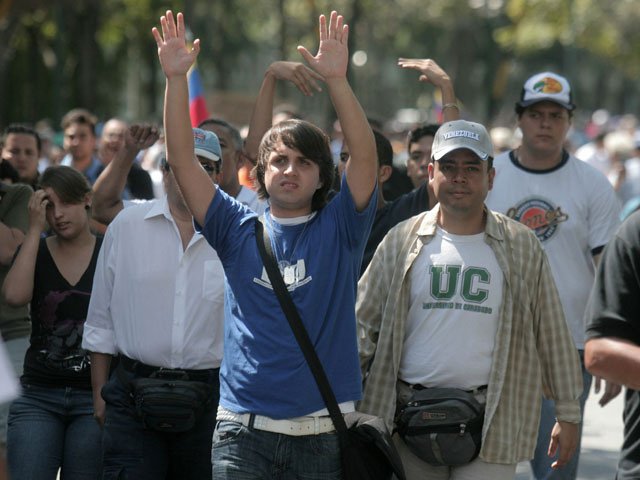
(Rafaels archive)
Rafael started to be involved in the movement a year before he went to college. He studied International Relations at the Venezuela Central University, the oldest university in the country. He was very well-known among the members of the movement and, 6 months after he entered the university, he was elected as a member of the Student Center. The moment he will always remember from this period is when the student movement actually achieved something important – it prevented the educational reform that would transform Venezuelan universities into socialist educational institutions. “This was around December and we went to the streets and we got oppressed, we had to run from the National Guard in motorcycles. We even spent New Year’s Eve at the university. It was a huge protest. And the good thing is that a few days after, Chavez who was already ready to sign the bill appeared on TV. He made a lot of excuses but he said, “No, I won’t sign it.” “We felt very important because even Chavez who was a dictator, somebody like Kim Jon Un in North Korea, his face is everywhere, his eyes are put everywhere, he is like a God. So making that God step back was something that made us and made me understand that it is possible with non-violent methods to make a tyrant regret.”
After he graduated from college, Rafael started to work for the non-government organization Humana y Libre (Human and Free) as an Academic Coordinator. The organization taught young kids from high schools or colleges in Caracas about human rights and non-violent methods. They were taught how leaders around the world had changed the realities without violence, with non-violent protests and how important it was.
“We were able to open different doors and talk to kids from middle-class families, or high-class, or low-class living in poverty, or even families who were pro-Chavez,” Rafael remembers. During the protests in 2014, Humana y Libre gave workshops to the protesters, to citizens from all ages. The aim was to inform them what tool they had to protect themselves from the huge repression they were facing, what books they could read, and what things they could do to keep themselves safe, to not get themselves killed but to maintain the protest. And the organization was so good at its job, that the government didn’t like it. The police stormed into its office and arrested a few members of Humana y Libre.
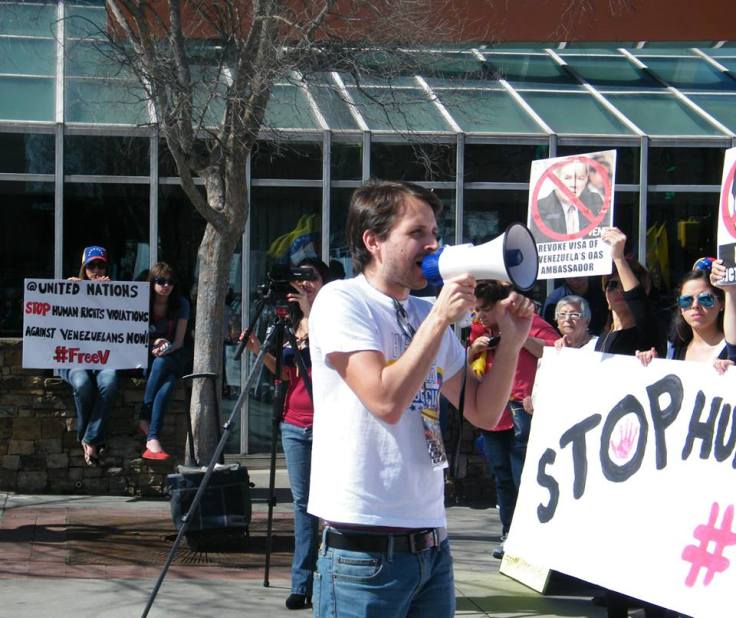
(Rafael’s archive)
The way out of the crisis
Rafael Olavarria admits that it is very interesting to watch Venezuela right now, because it is like a perfect storm, highly unpredictable. There are countries in the world with economic crisis, but they have democracy. There are other countries where the democracy is in crisis, but the economy is stable. And there is Venezuela, which like East Europe in 1989, has collapsed economy and repressive regime, and both of which cannot survive long.
The recent demonstration against Maduro’s regime in Caracas was attended by almost a million people and gave hope that maybe the time for change had come. Rafael is confident that there is no way out of the crisis with the government of Nicolo Maduro in power, so getting rid of it is the first step. The new government has to undertake a lot of unpopular measures to make the economy work again and it has to communicate these measures quite well in order to receive the confidence and the support of the citizens. Some of these measures concern the economy. The country has to return are to the open-market economy, and to cut national spending. The nationalized companies have to be returned to their owners, and the currency trade has to be liberalized. Other measures concern the social issues. Both the police and the jurisdictional system have to be reformed so the judges will send to prison criminals and not political opponents. The freedom of the speech must be respected. “The new government should give a chance to the best people in the country by putting them in the powerful positions. The destruction is very deep and it will take years, for example, to bring the highest inflation in the world to a normal level or the highest crime rate to a normal level.”
When asked whether he would return to Venezuela, the young man smiled and said that he would return only as a tourist or as an investor, but that his real life is here, in the US. And indeed, Rafael has found his way through American society. He used to work for Norcross Radio Informasion, a small internet radio station, almost as a “one man show”. The great work he did there and the contacts he made led him to CNN Espanol where he was trained in different areas including planning, coordinating talk shows, and newsroom. “This is the best job opportunity I have ever had. CNN is a big world, a great company. I learn a lot, and I am surrounded by people who know even more,” Rafael tells passionately.
To succeed in his new career, he even has to put aside his first big dream – to become a famous rock musician. These days he spends all his energy and time on his new goal. For Rafael Olavarria now “it is all about CNN”.
 Maria S. Topalova Blog
Leave a comment